
THE PULL OF THE EARTH
This is more than a record of rural Bengal. It looks at the bond between Sayan Biswas and the place that shaped him, even after distance has changed that relationship.
July 12, 2026
PICTORIAL STORY
PHOTOGRAPHY Sayan Biswas
TEXT Sayan Biswas
INTRODUCTION Melanie Meggs
Sayan Biswas returns to rural Bengal not as an outsider, and not simply as a son of the place, but as someone pulled back by something older than memory. Maatir Taan (The Pull of the Earth) is a story about inheritance under pressure. It asks what happens to knowledge when the hands that hold it grow older, and when younger generations are drawn toward cities, work, and other futures. Sayan is part of that movement. He has left, and still he returns. His photographs stand inside that uneasy space between attachment and separation, inheritance and change.
Sayan describes himself as a software engineer who happens to use a camera, drawn less to the identity of being a photographer than to the act of observing. That distinction is important. His photographs do not force meaning onto the people he photographs. They allow meaning to gather slowly. The camera becomes a way of looking at what might otherwise pass as ordinary, until it is no longer there.
Sayan’s photographs have received five National Geographic Editor’s Choice selections, third prize at the Indian Portrait Prize 2024, and have been exhibited across India and internationally. Such recognition reflects the strength of his eye, but the work itself begins closer to home, in the pull of a place that continues to shape him.
Maatir Taan is a record of return, but also a question about responsibility. What do we owe to the places that made us? What remains when the hands that carry knowledge begin to disappear? For Sayan, the answer begins with looking.
-min.jpg)
There is a particular quality to the light in rural Bengal. It arrives softly at dawn over paddy fields, turns brutal at noon on tin rooftops and river surfaces, and at dusk transforms everything it touches into something that feels less like the present and more like a memory already being formed. To photograph in this light, among these people, is to understand why Bengali poets and painters have always returned obsessively to the land itself, not as backdrop, but as living character.
Maatir Taan (The Pull of the Earth) is my ongoing documentary photography project set among the villages, riverbanks, festival grounds, and domestic interiors of rural West Bengal, India. It resists easy categorization. It is not journalism, though it documents. It is not anthropology, though it observes with care. It sits in the honest, complicated space between all of these things, which is perhaps the only space from which rural Bengal can be truly seen.
I am not a full-time documentarian. I am a software engineer living and working in Bangalore, thousands of kilometres from the Bengal I grew up knowing. My home is Kolkata, and beyond Kolkata, the villages, the rivers, the festival grounds, the earthen courtyards of rural West Bengal that exist in an entirely different rhythm from the glass towers and startup culture of India's technology capital. The distance between these two worlds is not merely geographical. It is the distance between a life spent in front of screens and a life spent in conversation with soil, tradition, and the slow, unhurried passage of seasons. Every time I return — camera in hand, software engineer by profession, Bengali by everything else — I am attempting to cross that distance. Maatir Taan is what that crossing looks like.
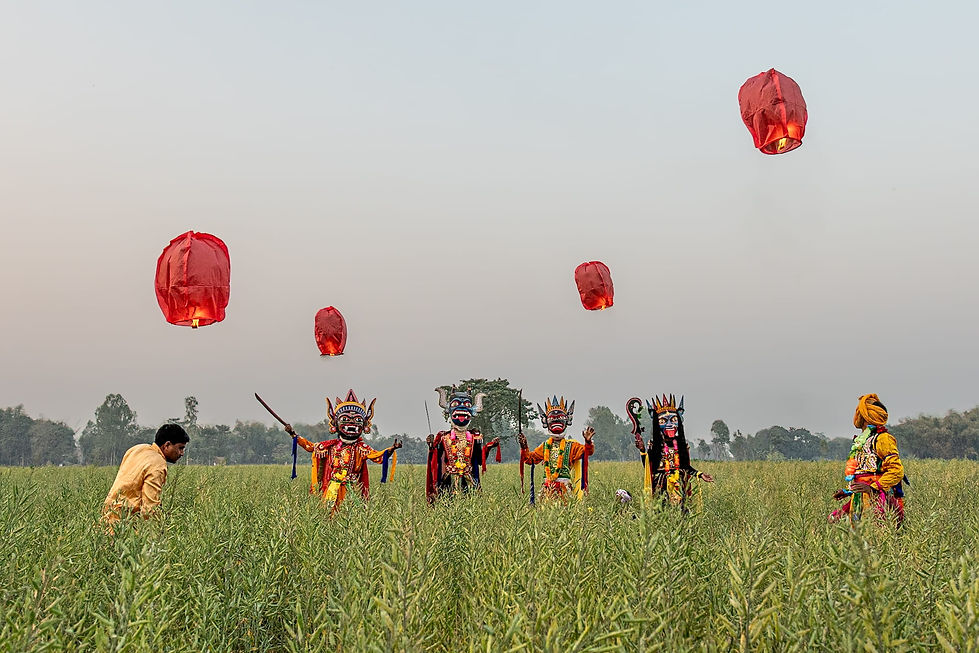
The project moves across the textures of village life without imposing hierarchy between the sacred and the mundane. I follow a Gomira mask carver working barefoot on an earthen floor, wood shavings falling like snow around a half-formed divine face. I photograph a Bohurupi performer costumed as a goddess walking through an open field while an ordinary woman passes behind him, neither particularly surprised by the other. Inside a bamboo home hung with painted masks, a mother tends a clay stove while her daughters study beside her. An elderly woman draws rice-paste figures at her doorstep with the ease of someone doing something her hands have always known. Fishermen spread great billowing nets of blue, green, and orange along the riverbank. A boy pushes his laughing face through a web of red yarn. Sky lanterns rise above Gomira performers standing in a green field at dusk. A grandmother holds a kerosene lamp aloft in a corn store and turns toward me with a smile of uncomplicated warmth.
What holds these images together is not subject but tone, expressed through my refusal to rank one life above another, my insistence that the extraordinary and the everyday are, in rural Bengal, the same thing wearing different clothes.
There is also an urgency beneath the beauty, one that I feel deeply and personally. The craftspeople I photograph are aging. Younger generations are leaving, many of them, like me, drawn toward India’s cities by opportunity and necessity. The knowledge held in a woodcarver’s hands, a ritual painter’s instinct, or a performer’s memory does not automatically survive. I cannot stop what is shifting, but I can look steadily and say that this existed, this was real, and it deserved to be seen.
মাটির টান (Maatir Taan) carries two meanings at once — the literal pull of soil underfoot, and the Bengali idiom for homesickness, the ache toward a place that shaped you. Both are true of this project. Both are true of me. And for a Bengali far from home, the camera has become the only honest way I know to go back.


Maatir Taan is more than a record of rural Bengal. It looks at the bond between Sayan and the place that shaped him, even after distance has changed that relationship. This is what gives the work its complexity. The pull of the earth is sentimental, but not only sentimental. It carries obligation, distance, and the uneasy knowledge that belonging changes once departure has taken place. From this place of partial return, Sayan Biswas asks what can still be carried, what has already shifted, and what photography can hold when memory alone is no longer enough.

The views, thoughts, and opinions expressed in the text belong solely to the author/s and are not necessarily shared by The Pictorial List.


