
DELTA DUSK
John Agather weaves image and text into a single current, tracing how music, memory, and daily life continue to move through the Mississippi Delta.
February 27, 2026
PICTORIAL STORY
PHOTOGRAPHY John Agather
STORY John Agather
INTRODUCTION Melanie Meggs
As the light recedes across the Mississippi Delta, John Agather photographs what holds after attention moves on. Delta Dusk is set in and around Clarksdale, where history is not staged but absorbed into daily life. John approaches the region through observation rather than assertion, allowing streets, buildings, and gatherings to register on their own terms. His camera stays close to moments shaped by use, habit, and quiet exchange.
The photographs unfold during the hour when clarity loosens. Buildings register long use. People meet the camera without request. Music drifts through scenes as part of the air rather than the event. John resists summary. He allows the place to speak through proximity, through what is shared and what is withheld. The Delta appears neither fixed nor fading, but active in its own terms.
John’s method is grounded in a long commitment to photography. He began working in black and white at fourteen, spending extended hours in the darkroom and learning to read time through exposure and restraint. Influenced by Atget, Erwitt, and Cartier-Bresson, he carries forward a documentary ethic shaped by patience and presence. Now based in San Antonio, his practice centers on street and documentary photography, informed by lived experience rather than distance.
What follows is John Agather’s narrative, written in conversation with his photographs. Neither medium serves as support or explanation. Image and text advance together, shaping a shared record of time spent, attention given, and experience gathered on the ground. In this exchange, the Delta is not translated or summarized but allowed to emerge through parallel acts of seeing and telling.
-min.jpg)
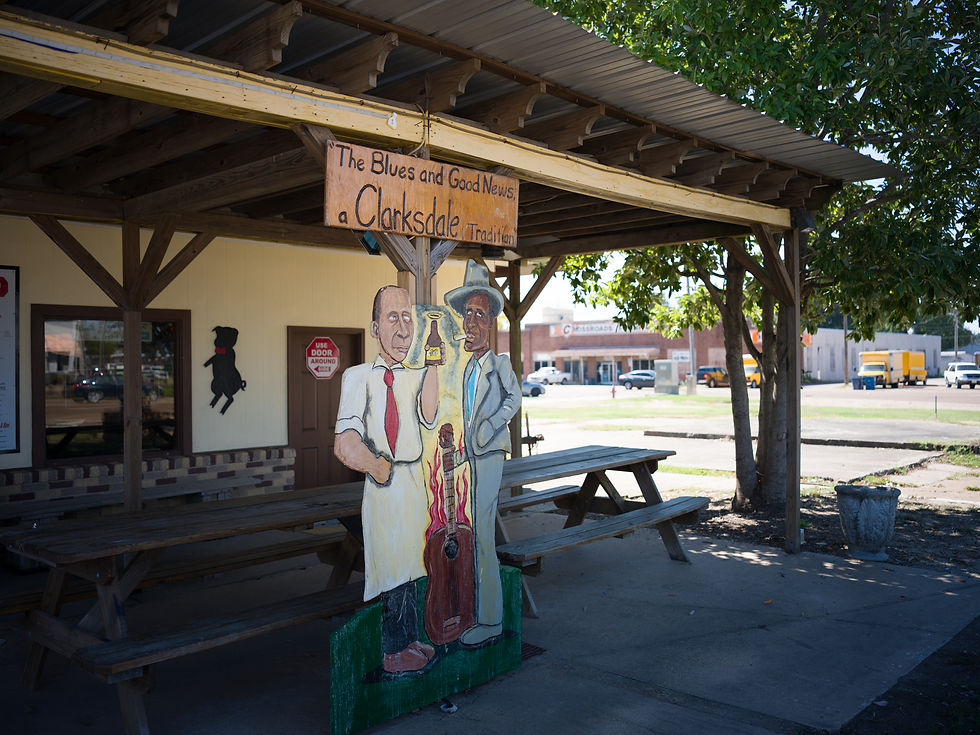
Clarksdale, Mississippi is no theme park. Unless you are from here, you are not qualified to pass judgement. Like a fallen branch floating along the nearby Sunflower River, there is an aimless quality while ambling along the ghostly streets of this storied home of the Blues. The air hangs with humidity amid the muffled sounds emanating from dimly lit juke joints. The desolate corridors of this once prosperous hub are lined with abandoned buildings. They range from shuttered multi-story brick towers constructed in the early 20th century to a high school deserted in the 1990s. On the edge of downtown is the fabled crossroads where rumor has it Robert Johnson traded his soul to the devil himself.
There are penetrations to the senses that leave you bewildered. Within the span of one block, a man sits on a street curb blowing a great blues riff on his harmonica, the smell of something deep fried stirs the soul, and there is a graffitied storefront that once sold high end goods sitting vacant. The combination is like a dystopian scene from a post-apocalyptic video game. The center of Clarksdale is a place of contradictions. People are friendly enough but distant. As you walk past one of the few pedestrians and wave a greeting, the answer is a muted response with a quick dart of the eyes down to the pavement. There seems to be a true wariness of outsiders, like maybe we are agents of the Robert Johnson pact.
As twilight descends on tall trees reflected in the river, moods start to change. Dimness is a friendly companion to the obscured urban canyon. Life awakens inside hidden rooms, music is played on impromptu stages, and laughter emanates from a joy that can only be rooted in pain. The Blues.
When seeds bourgeon, they grow at speed in uncontrolled directions. This part of the Mississippi Delta has touched the globe. Many forms of music can trace their ancestries right back here, especially rock and roll. When Elvis Presley exploded out of Sun Studios just up the road in Memphis, Tennessee, he was channeling the tunes that had sustained Clarksdale through war, famine, celebrations, funerals, and human struggle. The melodies came back reflected, changed, though not diluted.
Only six miles away is the heart of Stovall Family Farms. Founded in 1830 by William Oldham, this storied plantation is still owned by his descendants. There has been triumph and much tragedy in this legendary bloodline. But they endure. The Mighty Roots Music Festival is a testament to the creativity and love for this hallowed ground by an Oldham descendant, Howard Stovall. He decided to return to the land of his ancestors and honor the incredible art form born in this bend of the Mississippi Delta.
He learned in his youth at a dinner in Chicago from rock star Billy Gibbons, of ZZ Top fame, that the celebrated bluesman Muddy Waters was from Stovall Farms. He had no idea. That set Howard on a mission to investigate and breathe new life to the musical tradition that inspired the world. His promotional contribution to the world of music is profound, especially for the Blues.
After many ventures encouraging Blues festivals and clubs, Elvis Presley celebrations, and numerous other musical acts, Howard had a new dream. He and his wife, Baylor, invented the multi-day Mighty Roots Music Festival. It is hosted at an intersection of rural highways on the site of the cotton gin that had operated for Stovall Family Farms, a mere walking distance from what was once Muddy Waters’s home.
Howard has cleverly named this new jubilee in acclamation of the derivations of song that spring from the soil of his boyhood. The Mighty Roots Music Festival talent lineup is at once eclectic yet cohesive. There is a reason for that. Howard. Life is affirmed watching people pursue a passion. It is like an artist’s invitation is extended to climb inside a painting, a photograph, within a symphony, or any number of other human endeavors that are the result of someone’s thirst to reveal their vision for the meaning of our existence. At first glance, this gathering is not a commercial venture. It takes place in the middle of nowhere, has no well-known headlining acts, and spans everything from Zydeco to Outlaw Country ensembles. The band roster is a curated list that does not make sense in a music business model now dominated by the corporate limitations of earnings projections. The constant beat is the talent that is worthy in the birthplace of the music they play.
Surrounded by cotton fields as the sun begins to set, the old Stovall Farms gin mill logo glows above food trucks that offer concertgoers a range of options from steaks to burgers, quesadillas, and a local curiosity called a Kool Aid Pickle (it’s exactly what you think). The one clue that Howard is not a novice concert promoter is that you cannot walk 100 feet in any direction without encountering a retail opportunity; thankfully, most of them are bars. This is a modern-day hootenanny.
The last night ends with a plywood guitar-shaped sign being set ablaze as a sacrifice to who knows what....... A fire truck stands by just in case. In the wee hours of the morning, whoever is still left of the musicians, concertgoers, and volunteers all end up inside the crammed, timeworn roadside store that once sold bait at Stovall Farms. Rapt attention is paid to a pickup Blues group that features local legends, including Howard himself on the keyboards while his son, Quint, keeps rhythm on the drums.
The Mighty Roots Music Festival ends as it began, steeped in the love of music and family.




In Delta Dusk, John Agather shows what his practice stands on. The work is built through time spent in place, through returning and paying attention rather than arriving with an idea to prove. His photographs move quietly, allowing the Delta to register through what repeats and what lingers.
As part of our community, John’s project speaks to a shared understanding of photography as a way of staying with the world. The images and the writing hold the same ground, shaped by listening and care. Delta Dusk reflects a practice that values continuity over closure, reminding us that the work often begins by remaining present.

The views, thoughts, and opinions expressed in the text belong solely to the author/s and are not necessarily shared by The Pictorial List.


