
RUPTURE REPAIR REMNANT
In this reflection on rupture, Donna Bassin invites us to consider how grief settles into the body and the image, and how the slow work of witnessing becomes a form of repair.
March 8, 2026
PICTORIAL STORY
PHOTOGRAPHY Donna Bassin
STORY Donna Bassin
INTRODUCTION Karen Ghostlaw
Rupture is not an abstract condition but a lived one, registered in bodies, relationships, landscapes, and images. This text unfolds as an inquiry into how damage is acknowledged, carried, and worked through over time, without denial or premature resolution. Moving between artistic practice, psychological listening, and material process, it traces an ongoing engagement with mourning, witnessing, and repair, not as a return to an original state, but as an ethical labor that remains partial and unfinished.
This inquiry lives at the center of Donna Bassin’s work. A Brooklyn-born, New Jersey-based photo artist, filmmaker, writer, and clinical psychologist, she works at the intersection of art making and trauma care, where attention itself becomes a form of devotion. What breaks matters. What remains matters. She returns to her subjects over years rather than resolving them quickly, allowing loss and memory to shift, settle, and deepen in their own time.
Before turning to photography and film, Donna studied art therapy at Pratt Institute and worked as a handmade clay artist. Working with earth and touch taught her that surfaces remember.
Decades of work as a clinical psychologist and community worker with trauma and complex mourning deepened this understanding. Rupture leaves traces not only in bodies and minds, but in the materials, we handle and the images we hold. History gathers in wear, fracture, and repair. That awareness continues to shape her visual language.
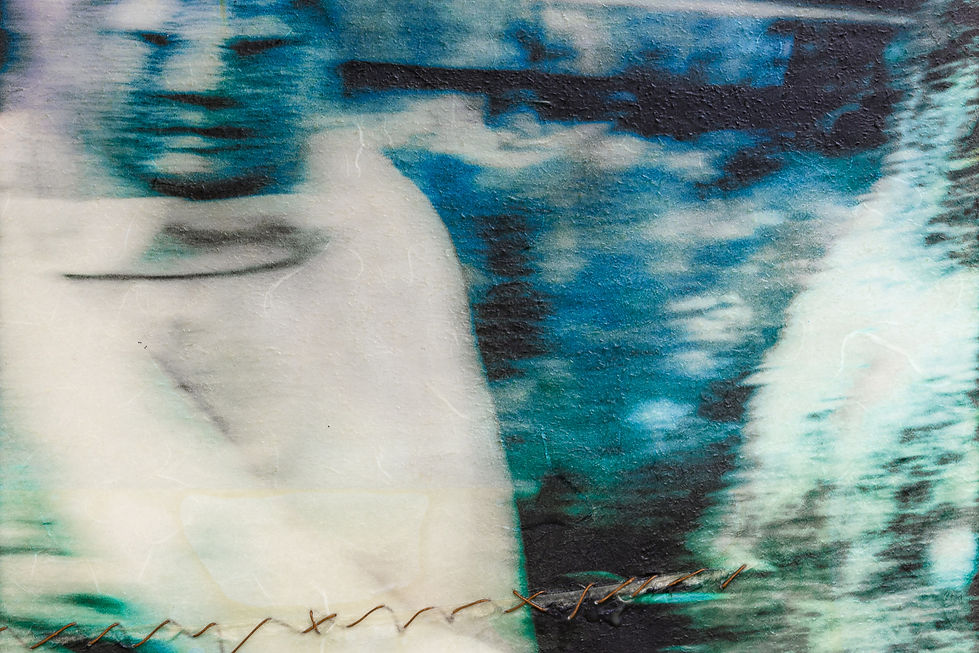
Her photographs resist seamlessness. They are burned, torn, punctured, sutured, and reinforced, sometimes with gold washi tape, so that damage remains visible and palpable. These gestures are not embellishment. They are acts of insistence. The image must carry what it has endured. Repair is present but never concealed. The scar is not erased. It stands as evidence of survival and of time passing through.
Collaboration and community extend this ethic beyond the studio. As a founding member and president of the board of Frontline Arts in New Jersey, Donna worked with veterans to transform military uniforms into handmade paper, a collective act of mourning that culminated in By Our Own Hand, a site-specific installation at the Montclair Art Museum. In these shared acts of making, the studio opens outward. Grief becomes something held together. Memory becomes communal. What cannot be undone can still be witnessed.
Donna’s practice is shaped by psychoanalytic listening, an attention to what is spoken and what remains unsaid, as well as by Japanese traditions such as kintsugi, which honor imperfection and visible repair. Her work resonates with artists who hold time within material form, including Hiroshi Sugimoto, Doris Salcedo, Anselm Kiefer, and Richard Avedon. Across these influences and through her own sustained inquiry, Donna asks us not to look away, but to remain with what has been marked, and to recognize that repair is not a conclusion. It is a practice.
-min.jpg)
The question beneath my work is straightforward: how do we live with what has been torn within us, between us, and around us without looking away? For me, repair begins with acknowledgement: naming the injury, registering the loss, and refusing the pressure to smooth it over or move on. Only then can mending begin, not as a reset but as a process—partial, visible, and ongoing.
Loss, trauma, mourning, and witnessing run through everything I make. I’m interested in how loss is metabolized (or not), how people protect themselves from the unthinkable, and how meaning evolves over time within relationships. I work in series and long-term projects, returning to subjects over years rather than resolving them quickly. This sustained attention has shaped bodies of work addressing social injustice, PTSD, and moral injury, and, more recently, the environmental crisis. In my series, Portraits of a Precarious Earth, I approach damaged and disappearing landscapes not as neutral scenery but as vulnerable subjects — sites where human action, denial, and responsibility are inscribed. The work asks how we bear witness to environmental harm without aestheticizing it away and how attention itself might become an ethical response.
I’m an artist working in photography, a filmmaker, a writer, and a clinical psychologist specializing in trauma and complex mourning. These roles are not separate; they form a single practice. Psychoanalytic training has taught me to listen for what is spoken and what is withheld, for what appears indirectly in gesture, tone, and the objects people keep. In the studio, I work with the same attention. I don’t treat images as declarations. I treat them as encounters; places where contradiction, vulnerability, and resilience can sit side by side without being forced into closure.
Formally, my practice often begins with the camera but does not end there. I work with photographs as physical objects, not merely representations. I intervene on the surface, tearing, burning, puncturing, reassembling, suturing, and layering physical prints. These actions are not embellishment or disguise. They are the content. I want the photograph to carry history, its vulnerability, and endurance, so the viewer meets not “perfect” beauty but a surface that has survived. The repair is visible; the scar is not hidden. I document what exists, then build a second truth on the image’s skin, the way people build second truths about themselves.
I care deeply about the image’s materiality, its weight, grain, fragility, and resistance, and I’m drawn to the edge of the photograph, where the frame typically contains and controls. Sometimes I let the photograph resist that containment. I push the boundaries of two dimensions by layering prints, lifting corners, building relief, and letting thread, paper, and tape move the image into space.
I want the work to register viscerally, engaging the senses and the body. A puncture is not just a mark; it’s a small act of violence and a record of it. A burn is not only a formal device; it’s an interruption that changes what an image can hold. Stitching can be read as repair, but also as urgency: as what must be held together, what cannot be restored, and what is still in need of care. Beauty matters here, too. I use color, light, and formal balance as thresholds that allow looking, especially at what many people would rather avoid. But I try to keep beauty ethically awake. The goal is not comfort; it’s attention.
My engagement with women’s issues is longstanding and specific. In my psychoanalytic writing, editorial work, and community practice, I’ve remained close to feminist questions, with particular attention to motherhood and maternal subjectivity, how attachment, memory, and mourning shape a mother’s inner world, and how cultural ideologies press on women’s lived experience. I’ve written about female development and sexual difference, including how “difference” can illuminate women’s complexity or be used to confine it. I also address embodied experience, including infertility, reproductive loss, and the stigma that often surrounds them. Across these efforts, the aim is consistent: to broaden what is thinkable about women’s inner lives without reducing them.
That commitment extends into my filmmaking and community-based work. In my award-winning feature-length documentary, Leave No Soldier, I deliberately included women who have served, including Vietnam-era nurses as well as female soldiers from the wars in Iraq and Afghanistan. Their presence pushes back against a cultural reflex that frames war experiences and moral injury as exclusively male stories. For me, this insistence on visibility is an ethical intervention that foregrounds women’s labor, endurance, injury, and post-war psychological lives.
The same ethical stance shapes my photographic series My Own Witness. It uses black-and-white portraiture and charged, familiar objects to make social fracture intimate, entering the body, the face, and the domestic and national imagination.


Alongside photography, Donna Bassin works in film, extending these ethical questions into time and lived duration. Her award-winning documentaries Leave No Soldier and The Mourning After examining moral injury, loss, and the long reverberations of violence. These films continue her sustained attention to what follows rupture rather than what neatly resolves it. Whether working with images, objects, sound, or collaborative processes, her practice is grounded in listening to what is spoken, what is withheld, and what quietly endures.
This sustained commitment has been recognized through numerous honors and exhibitions, including Time and Wisdom of the Land awarded Best Series by LA Photo Curator in 2024, multiple selections and finalist distinctions from Photolucida’s Critical Mass, recognition as a Top 50 Photographer in 2022 and Finalist in 2023 and 2024, support from The Puffin Foundation and the New Jersey State Council on the Arts, and residencies such as the Baer Arts Center in Iceland.
Her work has been presented at institutions including the Morris Museum, Newport Art Museum, Montclair Art Museum, the National Museum of Women in the Arts, and in international exhibitions across Europe, Asia, and North America.
In photography, film, writing, and clinical practice, Donna resists closure. She stays with what has been torn, within us, between us, and around us. Repair is not framed as restoration, but as an ongoing act of attention, visible, imperfect, and necessary.
The altered surfaces of Portraits of a Precarious Earth echo the marked bodies, domestic objects, and intimate interiors found in Donna’s work centered on women’s lives. In both, grief and endurance are inscribed rather than concealed. Repair unfolds slowly and remains visible. Whether the subject is land or body, the work asks what it means to remain present with what has been damaged, and what it requires to care for it.
Donna Bassin’s environmental work and her women-centered series are united by a shared ethical stance: a refusal of erasure. Across landscapes and across bodies, her images insist that injury be seen and that healing not be mistaken for disappearance. Vulnerability becomes a site of meaning, and attention becomes a form of care.

The views, thoughts, and opinions expressed in the text belong solely to the author/s and are not necessarily shared by The Pictorial List.


