
CONTOURS OF ABSENCE
Where concealment unsettles recognition and ordinary spaces turn psychological, the photographs of Serhii Fett suspend identity between presence and absence.
August 23, 2026
INTERVIEW
PHOTOGRAPHY Serhii Fett
INTERVIEW Melanie Meggs
Conceptual photography relocates the site of meaning. A photograph stops being a record of what stood before the lens and becomes the residue of a process, staging, symbol, performance, withholding. What the frame excludes carries as much weight as what it admits.
Serhii Fett works from within that uncertainty. He builds images that test the border between an external event and its psychological residue, treating memory, identity, and absence not as subjects to be illustrated but as pressures that reshape what the eye is permitted to register.
His training was self-assembled. Photography sits alongside philosophy, cinema, literature, and architecture in the framework he built for himself, and that framework shows in the precision with which he interrogates his own instincts rather than simply trusting them. Traces of Francesca Woodman, Bill Jacobson, Todd Hido, Rinko Kawauchi, Kumi Oguro, and Masao Yamamoto surface less as visual quotation than as inherited permission, permission to leave a photograph unresolved without leaving it unfinished.
The face, in this body of work, is treated as an obstacle rather than a destination. Concealed behind flowers, mirrors, signage, or constructed forms, it stops supplying the viewer with a shortcut to character. What remains, a posture, the angle of a wrist, the distance a body keeps from an object, becomes the more demanding evidence. Identity is not erased so much as relocated, forced to reveal itself through means slower and less certain than a glance at a face.
Color operates as an instrument of temperature rather than decoration. It gives these images an immediate clarity of surface even as their underlying situations resist explanation. This split, legible form wrapped around illegible content produces the work's particular unease. A photograph can look playful at first glance and grow colder the longer it is held in view, its humor thinning into something closer to restriction or estrangement.
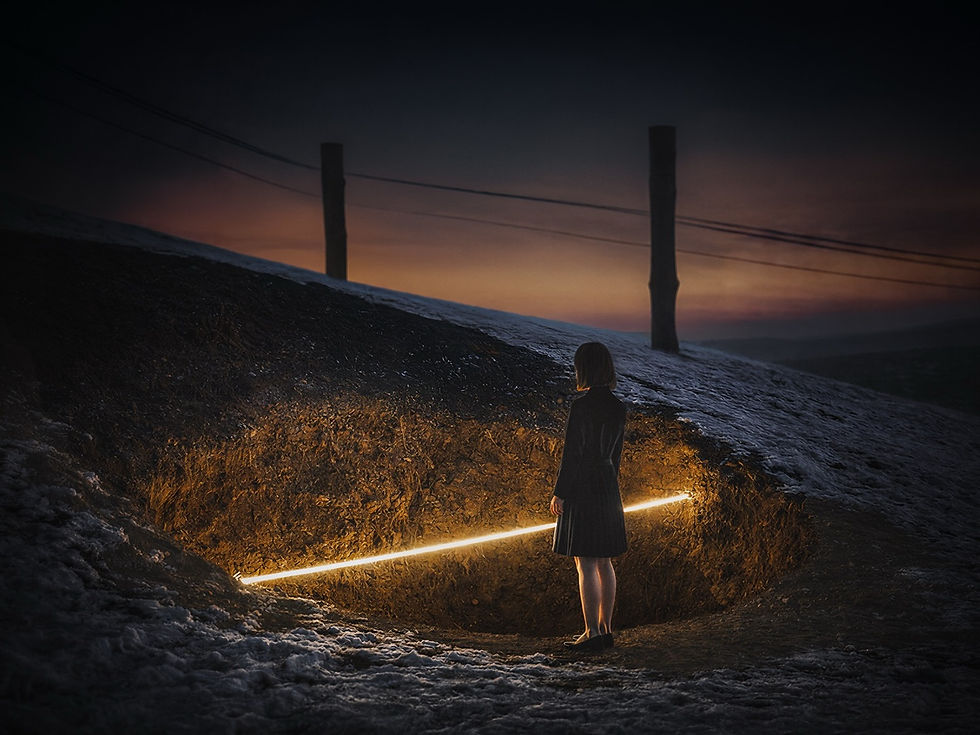
Relocating from Ukraine to Germany has inevitably affected Serhii’s relationship with place and memory, though it is not the explicit subject of the work. Space in his photographs functions primarily as a psychological element. Interiors, landscapes, roads, and ordinary environments shape how the body is perceived and contribute to the tension between presence and absence. Place becomes less a documentary fact than another component in the construction of an internal state.
Writing runs parallel to the photographs rather than beneath them, a separate instrument for a related inquiry. It gives Serhii a place to test his own reasoning in language, but it does not exist to complete the pictures. The photographs are asked to hold their tension without a caption's help, and what follows in this conversation is an attempt to trace how that tension gets built, and what Serhii believes a photograph should risk withholding even from its own maker.

“The starting point for me is usually not an object or a location, but an internal state. I am interested in experiences that are difficult to describe directly. Photography gives me a way to make those states physical. I construct my photographs rather than simply wait for situations to occur. I can control space, gesture, colour and the position of the body until the external scene begins to carry something psychological. At the same time, I do not want the image to become an illustration of a predetermined idea. It has to retain uncertainty. I am interested in that point where something remains recognisable and physically believable, but its normal logic has been disturbed. The viewer understands what is in front of them, but not necessarily what they are supposed to feel about it. That gap is important to me.”
IN CONVERSATION WITH SERHII FETT
By frequently concealing the face, your work challenges its conventional authority as the primary marker of identity within portraiture. What first prompted this inquiry, and how has shifting attention toward posture, clothing, gesture, and surrounding objects expanded your understanding of how a person may be represented and perceived?
The face is an extremely powerful source of information. As soon as we see it, we begin to form a specific person. We read expressions, age, mood and personality almost automatically.
For my work, that can sometimes be too much information.
I am usually not interested in creating a portrait of a particular individual. I am interested in the condition that the figure carries. Concealing the face allows me to interrupt that immediate identification and redirect attention toward the body, gesture, clothing, space and objects.
Once the face is removed, very small things become more important. The way a person stands, the position of the hands, the tension in the shoulders or the distance between the figure and an object can change the entire psychological reading of the photograph.
The figure becomes less biographical, but not necessarily less human. Sometimes the opposite happens. By removing a specific identity, the image creates more space for the viewer to recognise something of their own experience in it.
For me, concealment is therefore not about creating mystery for its own sake. It is a way of changing where identity is located within the image.
Concealment in your series can occupy a space between protection and erasure. How do collaboration and trust shape these constructed scenes, and how do you preserve the subject’s agency while withholding aspects of their identity?
There is an important distinction between concealing someone's identity in an image and treating the person themselves as anonymous during the process.
The photographs may remove the face or fragment the body, but there is still a real person physically participating in the construction of the scene. Because of that, trust matters.
A pose can be planned, but a body cannot be treated like a completely neutral material. People have their own physical limits and their own way of occupying space. Very small changes in posture can make an image feel completely different.
I try to preserve that distinction. The figure may become anonymous for the viewer, but the person making the photograph with me does not disappear from the process.
I also do not necessarily see concealment as purely negative. It can suggest disappearance or alienation, but it can also create distance, protection, or resistance. I prefer not to fix which interpretation is correct.
That ambiguity is closer to how I think about identity in general: not as something completely stable, but as something that can shift depending on context.
As a self-taught artist, can you recall when photography shifted from an interest to become something essential to your life? What changed in the way you saw yourself, and what gave you the conviction to pursue it as a sustained artistic practice?
Before I found my direction, I tried many different forms of photography. I photographed weddings and love stories, experimented with documentary and reportage photography, and generally moved through different genres trying to understand what photography could be for me.
The turning point came in 2017, when I consciously decided to leave commercial genres behind and concentrate on staged conceptual photography.
I realised that I was much more interested in constructing an image than in reacting to a situation that already existed.
That changed my relationship with photography completely. The camera stopped being only a tool for recording what was in front of me. It became a way to build a reality in which something internal could become visible.
I would not describe it as one dramatic moment when I suddenly decided that I was an artist. It was more a recognition that this was the form in which I wanted to continue thinking.
Once I found that direction, one image began to produce another question. That continuity was probably more important than any feeling of certainty.


How has self-directed study shaped the critical framework through which you examine your work, and what has it meant to become your own teacher and critic while maintaining independence from the conventions of formal art education?
Being self-taught gave me freedom, but it also meant that nobody gave me a structure.
I had to construct one myself through looking at photography and other visual art, reading, writing, making work, making mistakes, and gradually understanding what was missing from my own knowledge.
One consequence is that I became very interested in analysing why an image works rather than simply deciding whether I like it. I look at composition, gesture, colour, context, visual hierarchy, but also at whether there is actually an idea underneath all of those things.
That has also affected the way I judge my own photographs. One of the most useful things I have learned is that effort has no relationship to quality. A photograph can take days to construct and still fail. Another can be very simple and contain exactly what it needs.
Being your own critic is difficult because you are emotionally attached to the work. You have to learn to separate the process of making something from the result.
For me, independence does not mean rejecting art history, criticism, or other artists. It means being able to learn from them without treating any existing convention as automatically correct.
You create work that remains open to interpretation. How do you distinguish productive ambiguity from conceptual uncertainty, and has an unexpected response from a viewer ever prompted you to reconsider your understanding of an image?
For me, ambiguity is not the absence of intention.
A photograph can remain open while still being very precisely constructed. I may know why the body is positioned in a particular way, why an object is there, or why a certain colour dominates the frame. But I do not need the viewer to reconstruct my reasoning.
The distinction is whether the image creates a coherent tension or whether it is simply unclear because the idea has not been resolved.
I want to work somewhere between certainty and ambiguity. There should be enough information to hold the image together, but not so much that the viewer is left with only one possible conclusion.
No, I cannot point to a specific case where a viewer’s response made me reconsider my own understanding of an image.
Francesca Woodman, Bill Jacobson, Todd Hido, Rinko Kawauchi, Kumi Oguro, and Masao Yamamoto have each informed your thinking about photography. How have your encounters with their work expanded your understanding of the medium, and how do these ideas intersect with the questions you pursue within your own practice?
I am less interested in adopting another photographer's style than in understanding what their work makes possible.
With Francesca Woodman, I was drawn to the unstable relationship between the body, space, presence, and disappearance. Bill Jacobson showed me how uncertainty and the withholding of information can become active rather than simply incomplete.
Todd Hido made me think differently about ordinary environments and their ability to carry psychological weight. Rinko Kawauchi demonstrated how attention can transform something everyday without needing to make it spectacular.
Masao Yamamoto's work reinforced for me the importance of restraint and the possibility that a small or quiet image can contain a much larger emotional space.
With Kumi Oguro, I am particularly interested in the constructed body and in situations that are clearly staged but remain psychologically unresolved.
What connects these artists for me is not a single visual style. They all expanded my understanding of how much can remain unsaid in a photograph.
That has been very important for my own practice. I want to construct images precisely, but I do not want to close them.
Sometimes an image begins with a sentence, a contradiction or a short note. I have ideas that remain as words for a long time before I understand how they could become photographs.
You consider writing and image-making to be inseparable within your practice. How do these forms of inquiry interact across the development of a work, and does writing anticipate the image, evolve alongside it, or offer a means of critically interpreting the image afterward?
All three can happen.
Sometimes an image begins with a sentence, a contradiction or a short note. I have ideas that remain as words for a long time before I understand how they could become photographs.
In other cases, the visual idea appears first and I only begin to understand it properly through writing afterward.
Writing is useful because it forces me to articulate things that can remain vague while I am working visually. When I try to explain why an image matters to me, I can often see whether there is actually something underneath the visual solution or whether I am simply attracted to the appearance of it.
My writing about other artists has the same function. It makes me examine questions of authorship, representation, context and visual language from outside my own work, and then those questions inevitably return to my practice.
But I do not think a text should rescue a photograph.
If an image only becomes meaningful after a paragraph explains it, something is probably missing from the image. Writing is another way of thinking for me, not a set of instructions for the viewer.
As artificial intelligence assumes a greater role in the contemporary world, how do you critically understand its place within photography: as a practical tool, a creative collaborator, or an emerging medium with a distinct identity, and what does each position mean for authorship and photographic practice?
I think it is useful to separate these positions rather than treat AI as one single phenomenon.
As a practical tool, I see it as another development in the technological history of image-making. Photography has always changed together with its tools. AI can assist with research, previsualization, experimentation, and many parts of the workflow without necessarily changing the authorship of the work.
The idea of AI as a collaborator is more complicated. It can introduce something unexpected, and that can affect the direction of an idea. But for me, authorship still lies in intention, selection, rejection and responsibility. The artist decides what enters the work and, just as importantly, what does not.
I also think AI-generated imagery is becoming a medium in its own right.
I am increasingly unsure whether it is useful to call every synthetic image photography. Photography has traditionally maintained some relationship to something that existed in front of a camera, even when that reality was completely staged. A generated image has a different origin.
I do not see that difference as a hierarchy. I think it is simply important to name different media accurately, because each one raises different questions about reality, authorship, and evidence.
How does artificial intelligence enter your photographic process, and to what extent does it shape the image from its initial conception through to the final work?
I mainly use AI during the development of an idea and for previsualization.
Because my photographs are staged, there is often a considerable amount of work between an initial thought and the actual shoot. AI can function like a very fast sketchbook. I can test a composition, a gesture, the relationship between a body and an object, a location or a colour combination before committing to the physical construction of the scene.
Interestingly, its greatest value is often not in showing me what works but in showing me what does not. An idea can sound convincing in my head and become completely obvious or artificial once I see a version of it. That allows me to remove a lot before I photograph anything.
But I do not want the previsualization to dictate the final image. Once a real body, real light, real space, and real objects enter the process, the situation changes. Physical reality introduces resistance and accidents that are impossible to predict completely.
So AI can shape the path toward the photograph, but I do not want it to eliminate that resistance. For me, that is still one of the essential qualities of photography.


Growing up in Ukraine shaped your awareness of how ordinary surroundings can carry profound emotional meaning. Since relocating to Germany, how have memory and physical distance reframed this early way of seeing, particularly in your photographic exploration of place and belonging?
I moved from Ukraine to Germany because of the war. That inevitably changed my relationship with place, but I am careful not to use the war as an explanation for everything I make.
What changed very strongly was my awareness of things that had previously seemed completely ordinary. When you live inside a familiar environment, you stop noticing many of its details. Distance changes that. Something as simple as a particular interior, landscape, colour, road or object can suddenly become connected to memory.
Living in Germany also made the idea of belonging less fixed for me. You can physically inhabit one place while another continues to exist very strongly in your memory.
But I do not want to photograph Ukraine or Germany as geographical subjects. In my work, space is more often a psychological element. A room, a landscape or a road can influence how a body is perceived and change the emotional weight of the image.
So physical displacement has certainly affected the way I see, but I am more interested in what it reveals about a person's internal relationship with their surroundings than in turning geography itself into the subject.
Looking across the development of your practice, where do you recognize the most significant transformation in yourself, and how has this change shaped the way you understand your work and your identity as an artist?
The most important transformation was probably moving from trying different photographic genres to understanding that I wanted to construct images around ideas and internal states.
Before that, I was looking for my place inside photography. Once I chose staged conceptual work, I stopped asking which genre a photograph belonged to and became much more concerned with whether every element inside the frame was necessary.
That changed the role of almost everything: the body, location, object, gesture, empty space and colour all became deliberate parts of the construction.
My relationship with colour has also changed significantly. I do not think of it as decoration or as something that simply makes an image more attractive. It can alter the psychological temperature of a scene. Sometimes the palette is restrained; sometimes colour is very direct. What matters is what it does to the state of the image.
I have also become less impressed by technical difficulty for its own sake. A complicated photograph is not necessarily a strong photograph.
Increasingly, I am looking for clarity: the minimum number of elements necessary to create a psychological tension without explaining it away.
What questions are beginning to occupy you now, and how might they shape the next stage of your work? Looking toward the next stage of your practice, what would you most like to accomplish, and is there anything on the horizon that you would like to share with us?
I am becoming increasingly interested in how far a constructed photograph can move away from ordinary reality while remaining psychologically believable.
That balance between the real and the invented has always been present in my work, but I feel there is much more to explore there.
I am also interested in how little information an image actually needs. How much of a person can be removed before their presence becomes stronger rather than weaker? How can an ordinary object change the psychological meaning of a body without becoming a simple symbol? How can colour carry emotion without becoming decorative?
Artificial intelligence adds another layer to these questions because it is changing our relationship with photographic reality itself. As synthetic imagery becomes increasingly convincing, the distinction between something that existed physically and something that was generated becomes more complicated.
At the same time, I do not want technology itself to become the subject of everything I make. The central questions remain human for me: identity, alienation, uncertainty, presence, absence and the unstable relationship between what we appear to be and what we experience internally.
At this stage, I am less interested in producing more images simply for the sake of production. I want to develop more sustained bodies of work, push the visual language further and make the relationship between individual photographs stronger without taking away their ability to stand on their own.


