ARE THOSE WINDS
Along Istanbul’s northern edge, Ci Demi photographs the last water buffalo herders as they keep working, remembering, and staying put while the city closes in.
May 24, 2026
PICTORIAL STORY
PHOTOGRAPHY Ci Demi
STORY Ci Demi and Melanie Meggs
Ci Demi did not arrive at photography through a formal route. Born in Istanbul in 1986, he studied Italian Literature at Istanbul University and came to photography at twenty-eight. The shift began during the Gezi Park uprising in 2013, when he found himself using his phone not casually, but with purpose. “I found myself not chanting slogans but photographing everything using my phone; it was instinctual,” he recalls. “Right then and there, I decided I wasn’t meant to be an escapist writer but a witness.”
That distinction between escape and witness continues to shape his practice. Istanbul appears as a system of pressure, memory, disappearance, and response. His photographs ask what remains, what is being removed, and what forms of life continue under conditions of urban expansion.
Although photography entered his life after literature, his earlier training remains present. “I have always been a storyteller in some form or another,” he says. “My literature background helped me write the stories first, then continue collecting images for them. While my work isn’t staged, I would say it’s constructed much like a novel.” This sense of construction is central to his method. His photographs accumulate through walking, returning, observing, and waiting until a structure begins to emerge.
-min.jpg)
Demi’s debut photobook, Şehir Fikri (Notion of a City), published by Onagöre in 2022, presented Istanbul through absence. Inspired by Georges Perec’s La Disparition (A Void, 1969), the book removed people, animals, and language from the city. What remained was not emptiness, but a study of urban presence without human anchoring. In that work, Istanbul becomes a field of withheld information: seen but not explained.
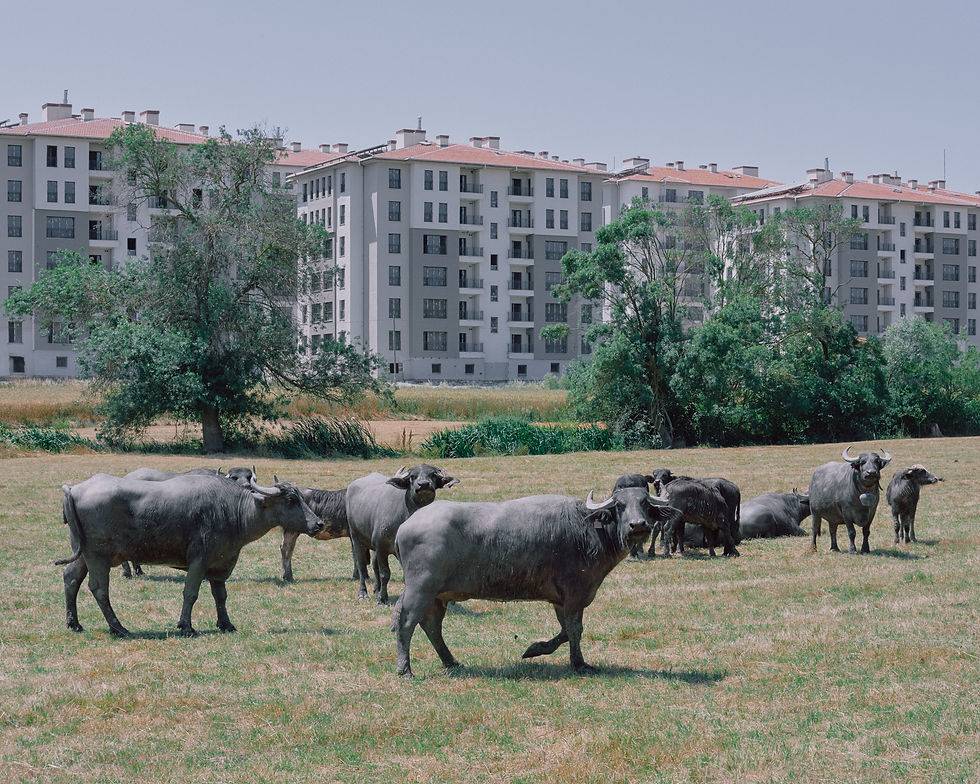
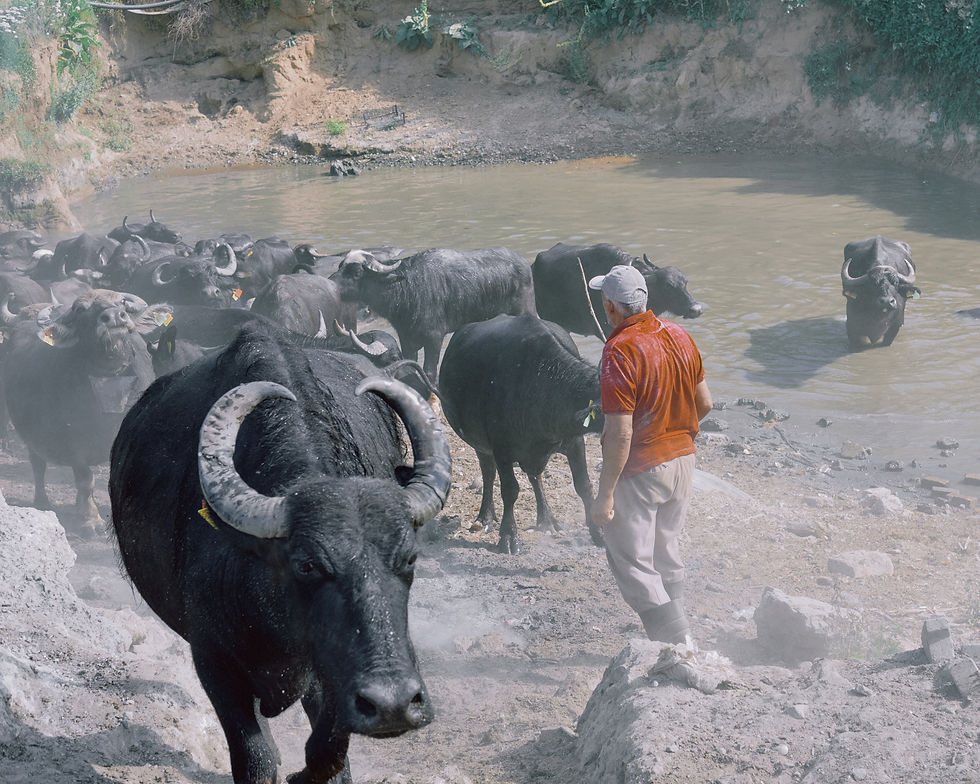
His ongoing project Are Those Winds marks a shift. Here, the human figure returns. Animals enter the frame. Labor becomes visible. The series documents the owners and herders of Istanbul’s last remaining water buffaloes in the city’s northern outskirts. First commissioned by Climavore x Jameel at RCA, the portraits were exhibited and used in campaigns for the September 2025 Water Buffalo Festival, or Manda Festivali. Demi has since developed the project independently, with the organization’s permission, expanding it from portraiture into a wider study of landscape, livelihood, and displacement.
The work began before it had a fixed form. Demi first visited Istanbul’s northern outskirts in 2017, where he encountered a herd of water buffaloes walking along the road. At the time, the third bridge connecting Asia to Europe had recently been completed, despite public opposition. For Demi, this moment signaled a larger transformation. “There was certainly a story there,” he says. “That started the relentless expansion of the city. My ‘instinct’ was to document what was going on.”
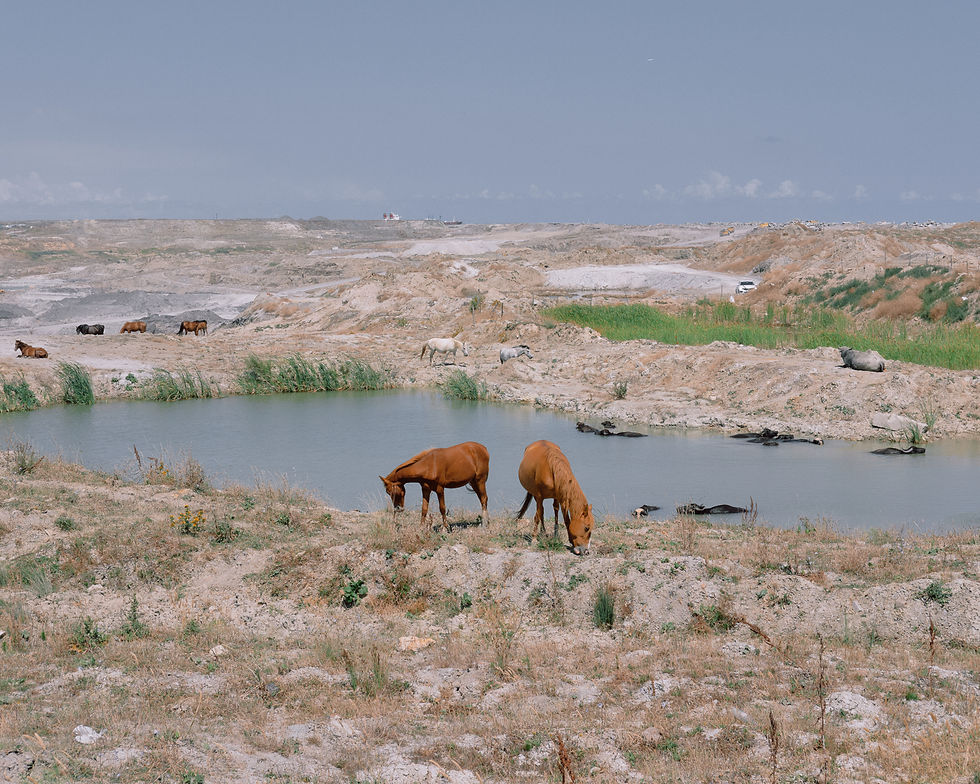
For years, he returned and made images without a resolved framework. The commission gave him access and clarified the stakes. “It was an incredible opportunity to embed myself in the landscape,” he explains. “My brief was to make portraits, for the most part, but during our visits to the north, I kept looking around, collecting bits and pieces of the landscape. The change was rapid and ruthless. I saw a complete erasure.”
The communities Demi photographs practice mandacılık, the traditional rearing of water buffaloes. They produce milk, kaymak, and buffalo milk ice cream. These practices are not presented as folklore. They are forms of labour, economy, inheritance, and spatial knowledge. They hold a relationship between people, animals, wetlands, and land use that is increasingly incompatible with the city’s current direction. Mining pits, shopping malls, metro extensions, and development triggered by the new Istanbul Airport now press against these agricultural zones. Villages once positioned at the city’s edge have become contested terrain.
Demi’s portraits place the herders beside the animals they care for. This is not simply a compositional decision. It is the conceptual center of the work. The photographs insist on interdependence. “The water buffaloes act much like distrusting stray cats,” he says. “They are very skittish, they just observe you, and in the end, they run away. You have to have a bond with them to get closer.” For Demi, the portraits become evidence of trust. “The pictures are about invisible things: visually, there is affection. Yes, I can safely say that those photographs document mutual affection. You see, their lives depend on each other, especially in the wake of this ongoing ecological disaster.”
This attention to affection prevents the project from becoming only an account of loss. The political context remains unavoidable, but Demi does not reduce the herders or animals to symbols. He photographs them as participants in a way of life continuing under threat. The work is therefore less about nostalgia than dependency: between human and animal, wetland and livelihood, memory and survival.
The title has also changed. The project was previously called Erasure, a title that named the violence directly. “One single command from a certain someone is enough to completely erase history,” Demi says. “Erasure came from that simple fact that we’ve had to accept. It was direct and, at the time, I thought the story needed a one-word title to shoulder the impact.” Yet as the work developed, the title began to feel too broad. Against the current political climate and the scale of violence across the region, Demi felt the word could no longer hold the specificity of this story. “My story was only a small part of what’s wrong,” he says. “I had to make it more personal.”
Are Those Winds shifts the project away from declaration and toward uncertainty. The title is a question without a question mark. It refers to forces that cannot be fully seen but are felt through their effects. “It is plural because there are many intertwining variables that we cannot possibly see,” Demi explains. “We only feel the strong winds of the north.” This reframing matters. Erasure names the outcome. Are Those Winds attends to atmosphere, pressure, and perception. It allows the work to remain political while becoming more intimate in its address.
Demi’s relationship to Istanbul is central here. He describes his work through psychogeography, a term he encountered when another writer used it in relation to his photographs. He adopted it because it described how he understands the city: “To me, it’s how people and I interact with the city, and how the city responds to us; which, in many ways, it does.” His practice begins with curiosity. He follows the story first, then the images emerge through walking over days, weeks, or months. “There is certainly a language to my pictures,” he says, “but how it comes to be is a complete mystery even to me.”
Demi does not present himself as an external observer of Istanbul. He is connected to the city he photographs. “I would say I’m a documentary photographer who works mostly on the streets but, at the same time, points his camera at himself,” he says. “To my eyes, my presence, whilst being completely absent visually, is very apparent in my work.” In Are Those Winds, that absence is not withdrawal. It is position. The photographer is not pictured, but his relation to place structures the work.
The urgency of the project is practical as much as conceptual. The land is changing quickly. Access narrows. Sites close. Construction zones appear where open space once existed. “The place gets smaller and smaller with each visit,” Demi says. “The spaces you can access get more limited by the day.” Once a construction site is established, entry often becomes impossible. “The security guards are often very aggressive,” he notes. “They act secretive because, deep down, every sensible person knows that what has been going on is ‘wrong.’ They are doing something wrong; this fact hangs in the air at all times.”
Time, in this project, is not a neutral condition. It determines what can still be photographed. “Everything we see there today won’t be there as soon as tomorrow,” Demi says. “I had to accept this, which isn’t exactly the easiest thing.” This produces pressure throughout the series. The work is being made inside transformation, while the ground of the story continues to shift. “I feel a constant urgency,” he says. “A panic, even.”
Yet Demi is careful about the limits of photography. He does not overstate the power of the image to intervene. In relation to ecological justice and land use, he sees a gap between opposition and mobilization. Many people in Istanbul, including those close to him, only learned of the water buffaloes and the history of herding through this project. “The tradition will be erased, and we will have been mere helpless witnesses,” he says. “Will what I’ve been trying to show help? ‘At least there will be documents,’ I keep telling myself.”
This sentence carries the burden of the work. Documentation becomes both insufficient and necessary. It may not halt development. It may not protect the wetlands. It may not secure the future of the herders or their animals. But it refuses the silence that often follows disappearance. It establishes a record where official narratives produce omission.
As Are Those Winds continues, Demi’s attention is expanding. The first stage centered on portraits of water buffaloes and herders, shaped by the original brief. Now, he feels compelled to construct a broader portrait of place. “The landscape is ever-changing, and I’m currently focusing my efforts on documenting as much as possible,” he says. “The water buffalo and human portraits came first, but I feel the need to make a thorough portrait of the place, too.”
The project’s future is tied to uncertainty. Demi is not working toward a predetermined narrative arc. Unlike his other personal projects, which he describes as being structured like novels, this work depends on unfolding history. “I’m looking for an ending, and a curiosity about whether I’ll be there to witness it,” he says. “This story hasn’t developed like my other personal stories did: I can’t shoot a novel with this, as it depends upon unfolding history. It’s purely documentarian, in that sense.”
What remains unresolved is whether the communities he photographs can continue within fragments of land left behind by development. Demi does not pretend optimism. “I keep thinking about how long the herders and animals will be able to resist,” he says. “Can they exist in small pockets of land that the ‘powers’ will leave them with?” His final question is the one the work turns back toward its audience: “Will people even care?”




Are Those Winds does not answer that question. It holds it open. Through portrait, landscape, colour, and return, Ci Demi constructs a record of a city remaking itself through loss. The work asks what it means to witness when the outcome may already be underway. It asks what photography can do when it cannot stop the forces it names. Most importantly, it refuses to let disappearance occur without being seen.
The views, thoughts, and opinions expressed in the text belong solely to the author/s and are not necessarily shared by The Pictorial List.


