COLORS OF HUZUN
Through fragments and gestures, Pedro Vidal traces Istanbul as shared melancholy lingers in everyday life, the city unfolding slowly and refusing to settle into a single, definitive understanding.
May 10, 2026
PICTORIAL STORY
PHOTOGRAPHY Pedro Vidal
STORY Melanie Meggs
Pedro Vidal approaches Istanbul with a quiet assurance, shaped by a sense that the image does not need to assert itself. He came to photography after studying International Relations, and that detour matters. It brings a measured patience to his work, along with an awareness that looking is never neutral and that understanding, particularly across cultures, remains partial. Born in Brazil and now based in Barcelona, his path to the medium informs a practice attentive to the conditions of encounter. He describes photography as “a passport to places and situations where I wouldn’t be if it wasn’t through photography,” a statement that frames his practice not as possession, but about entering it in a limited and uncertain way.
This position shapes Colors of Hüzün from the outset. Pedro does not attempt to master Istanbul. He circles it. He watches. He allows it to remain partially out of reach. That distance is not a limitation. It is the structure of the work.
-min.jpg)
The project enters into a long history of attempts to define Istanbul, many of them marked by a desire for totality. The line by the 19th century French writer, poet, and statesman Alphonse de Lamartine, “Let my last look upon the world be upon Istanbul,” offers the city as a final image, a place capable of containing everything at once. Pedro does not confront this idea directly. Instead, he works around it, producing a sequence of photographs that quietly dismantle the possibility of such a conclusion. “It is not the intention of this work to explain, nor even to understand, Istanbul,” he writes. “The images reflect a fragment, an interpretation.” What is at stake here is not definition, but relation.
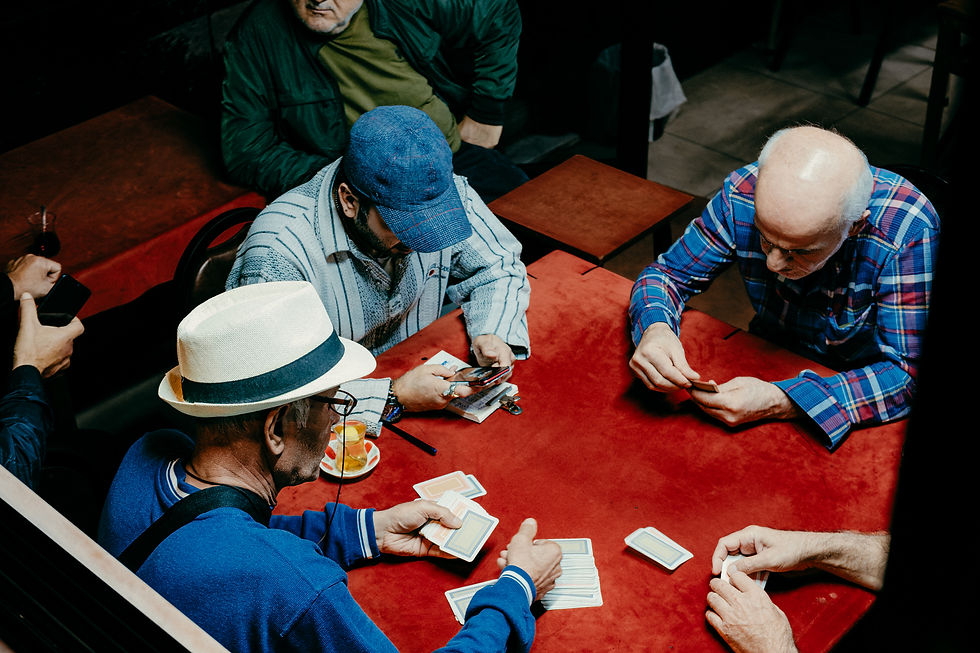
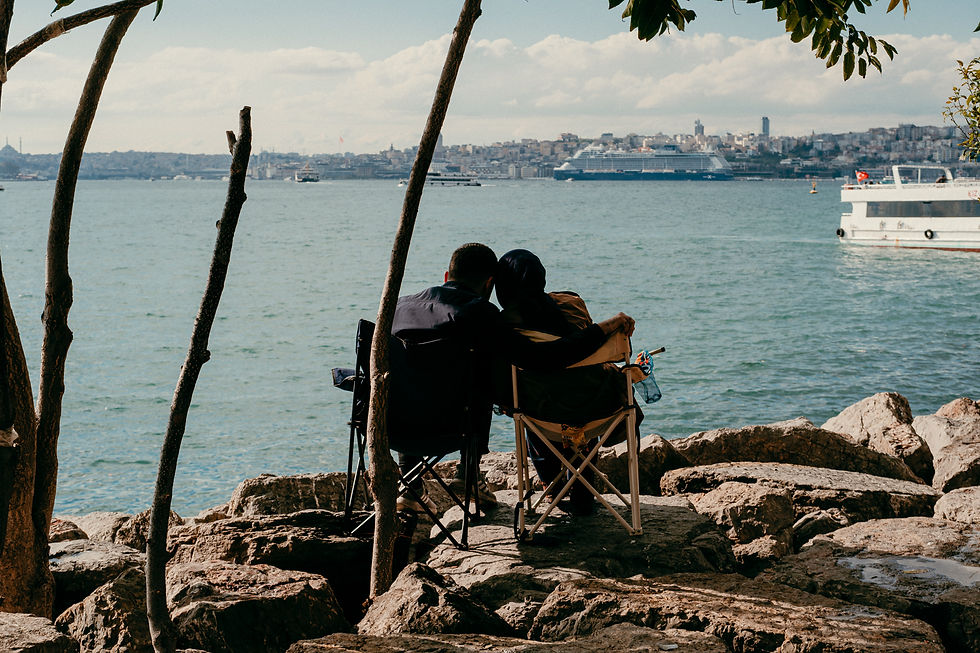
Within the photographs, this approach becomes visible in how nothing is made to feel more important than anything else. Men sit around a red table, focused on their game as it simply continues. A pigeon is held open in someone’s hands, and it’s hard to tell exactly what is happening. People gather by the Bosphorus, not taking in the view in any grand way, but just going about their time. These are not decisive moments. They are ongoing ones. Time does not peak. It accumulates.
This is where Pedro begins to explore the idea of hüzün. Drawing on Turkish novelist and Nobel laureate Orhan Pamuk, whose writing situates hüzün as a collective condition shaped by Istanbul’s historical consciousness, Pedro understands it not as individual sadness, but as a shared affect that informs everyday life and mediates the relationship between people and their surroundings. It is not something dramatic or easily seen, but something quieter that sits within ordinary moments. He does not try to show this feeling directly. As he says, “To photograph is to represent, and all representation arises from a particular reading.” What we see in the images is shaped by his perspective, not a fixed truth. In this way, hüzün is not clearly shown but gently felt, appearing in small gestures, in how people gather and move, and in moments that are left open rather than explained.
Color plays a critical role in this structure. Pedro writes that “the colors and forms reproduced in the images are like verbs or adjectives in a poem,” and this analogy holds. The repetition of reds and blues does not embellish the scenes. It organizes them. A red table anchors a group of men. Blue surfaces extend through walls, water, and sky. These elements create a visual syntax that binds the work together while allowing each image to remain distinct. The photographs do not rely on narrative continuity. They rely on formal coherence.


What the work ultimately resists is closure. It does not summarize Istanbul. It does not translate it into something easily grasped. Instead, it maintains a state of partial legibility where the city remains open and unresolved. This resistance returns us to Lamartine. If his statement proposes Istanbul as a final, encompassing vision, Pedro Vidal’s photographs suggest the impossibility of such a view.
There is no last look here.
What Pedro offers instead is an accumulation of encounters, fragments that refuse to settle into a singular image. Istanbul does not appear as something that can be finished with. It exceeds the frame. It continues beyond it. In allowing this, Pedro positions his photography not as a means of capture, but as a form of sustained attention. A way of remaining in relation to a place that cannot be fully known.
The views, thoughts, and opinions expressed in the text belong solely to the author/s and are not necessarily shared by The Pictorial List.


