
OUT OF PLAY
An exploration of abandoned interiors in which Marco Lugli examines how objects, light, and space carry memory beyond human presence, establishing absence as a condition of material continuity rather than loss.
May 3, 2026
PICTORIAL STORY
PHOTOGRAPHY Marco Lugli
STORY Marco Lugli
INTRODUCTION Melanie Meggs
Marco Lugli’s photographic practice develops alongside his work as a mechanical engineer in the hydraulic sector. Based in Reggio Emilia, Italy and active within the Refoto Association’s conceptual laboratories, his approach is shaped by the conditions of two distinct yet connected worlds. His professional life operates through structure and precision, while his personal life moves through a more shifting terrain, shaped by complexity and the movement of emotion.
Photography emerges within this interval as a space of release from fixed systems. The camera becomes a way of engaging what cannot be calculated, where intuition operates alongside control, opening a space beyond the limits of technical reasoning.
Working in black and white, Marco reduces the image to its essential elements, allowing form and space to carry weight. He describes this approach as “entropic minimalism”, a condition in which clarity and instability coexist. His process moves through experimentation, attending to absence and restraint as a way of revealing what remains just beyond immediate perception.
In Out of Play, Marco Lugli turns to interior spaces that continue beyond their use, where objects and light hold their position, and the image becomes a site in which memory is sustained through material conditions.
-min.jpg)
Out of Play explores the fragile afterlife of spaces once shaped by human presence, capturing the silent persistence of objects that remain long after the gestures around them have faded. The series moves through abandoned rooms where time has settled like dust, thick and unmoving, yet illuminated by thin, deliberate lines of light. These beams carve open the darkness, revealing a stage where the remnants of play, rest, and routine become reluctant protagonists. Through them, the photographs trace the tension between what has disappeared and what insists on staying.
The foosball table stands at the center of this tension. It appears not as a relic of entertainment but as a vessel of memory: a field without players, suspended between possibility and loss. Its rigid figures, its rusted rods, and its uneven legs collectively evoke a game that cannot continue and yet never truly ended. Nearby, a drawer left half open suggests a gesture interrupted—an everyday action caught at the moment it slipped out of time. Chairs, overturned or exhausted, testify to bodies that are no longer there; they hold the imprint of a weight that has vanished but not been erased.
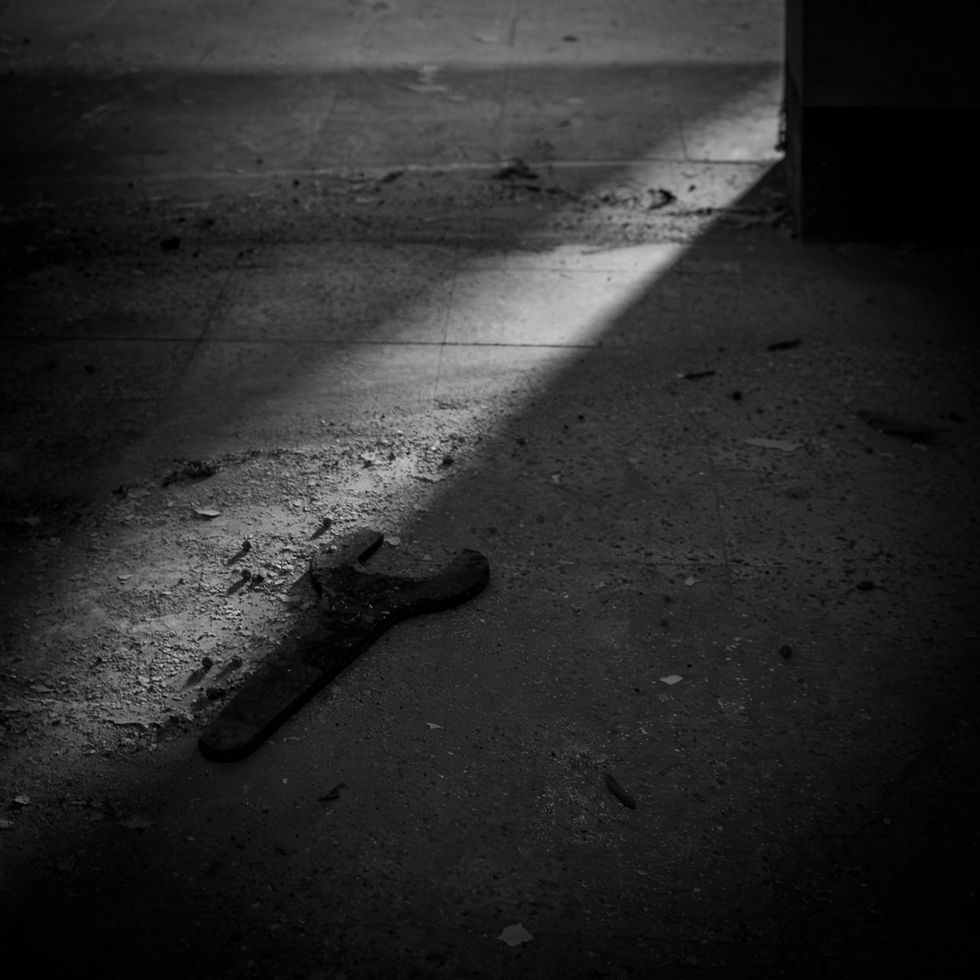
Light becomes the narrative thread binding these scenes together. It arrives obliquely, never frontal, as though aware of the fragility of what it touches. Its presence does not revive the spaces but reveals their endurance. It transforms dust into texture, walls into maps of erosion, floors into quiet archives of small debris. In each photograph, the light reads the room like a memory reads emotion: indirectly, partially, yet with surprising clarity.
Beyond their physical decay, these interiors speak of a deeper persistence. The rooms do not mourn abandonment; instead, they hold onto the emotional residue of time lived and time stopped. The artifacts of play — whether the foosball field or a paper boat resting in an unexpected corner — resonate with echoes of childhood, rules, and imagined journeys. They hint at the invisible threads connecting past actions to present silence.
Out of Play ultimately reflects on the resilience of memory in its most material form. It suggests that objects continue to perform even when their audience has disappeared, continuing the script of everyday life in muted tones. The absence of people does not empty the rooms; it sharpens their presence. The series invites viewers to consider that spaces, when left alone, do not forget. They wait, they absorb, they transform. And in doing so, they challenge us to look at what remains not as ruins, but as witnesses — quiet, patient, and profoundly human.




Taken together, Marco Lugli’s photographs and text establish a framework in which absence is understood through material continuity rather than loss. His work redirects attention from what is no longer present to how meaning is retained within spatial relations. In doing so, Marco proposes a mode of reading interiors grounded in observation rather than narrative reconstruction. The essay suggests that these environments function as active sites of accumulation, where time is registered through subtle shifts rather than visible events. What is encountered is not closure, but an ongoing condition, where the viewer is required to engage with what persists and to recognize the capacity of space to hold and transmit experience beyond its original use.

The views, thoughts, and opinions expressed in the text belong solely to the author/s and are not necessarily shared by The Pictorial List.


