
A HOME OF MEMORIES AND THE PRESENT
Davide Santangelo returns to his family home by moonlight, tracing how absence, memory, and love continue to live within place, objects, and atmosphere after loss.
July 16, 2026
PICTORIAL STORY
PHOTOGRAPHY Davide Santangelo
TEXT Davide Santangelo
INTRODUCTION Melanie Meggs
There are places that keep living inside us long after they have changed. In A Home of Memories and the Present, Davide Santangelo turns toward the family home and its surrounding land as a place of return, but also as a place where absence has altered the meaning of everything once familiar. Since the passing of his mother, this domestic landscape has become charged with another kind of presence. Trees, rooms, sounds, meals, and conversations remain as imprints of a shared life, forming a quiet architecture of memory that continues to shape the present.
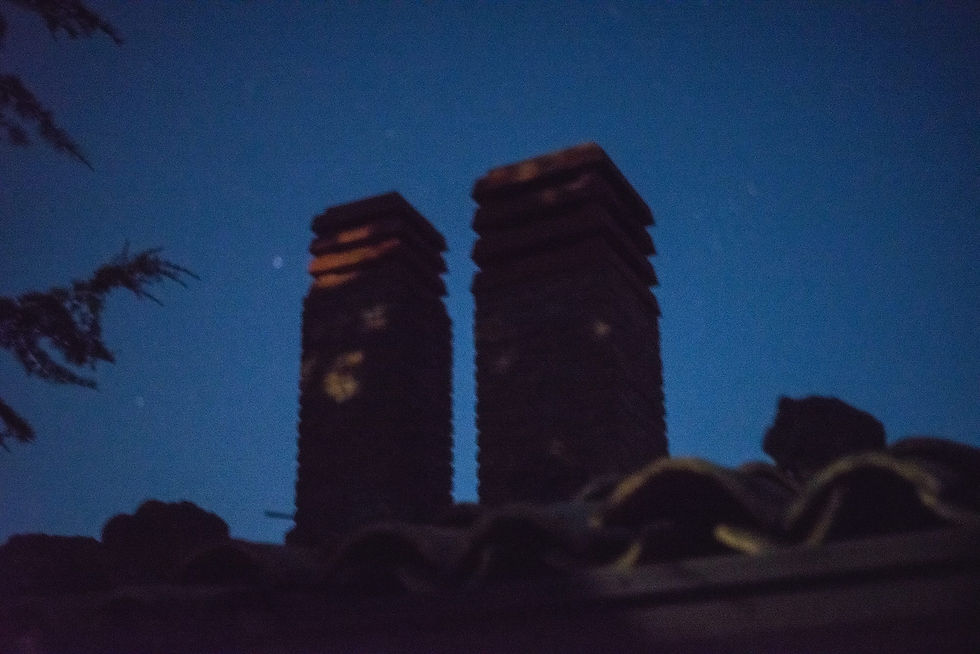
Captured entirely by moonlight, the project enters the home through a slower and more uncertain way of seeing. Forms emerge gradually, held between recognition and disappearance, as if the rooms, objects, and surrounding land can only be approached through what darkness allows. Rather than fixing the place in detail, Davide lets it remain open, suspended between the visible world and the inner life it continues to hold.
Davide’s wider practice gives this project its ethical structure. Davide continues to live and work in Sicily, where his photographic practice is shaped by sustained involvement in social care, cultural programming, and community-based projects. His photography has grown from civic engagement and from an attention to lives and experiences that often remain unseen. In 2010, he co-founded La Locomotiva Cinema e Musica, a cultural association in Adrano that became a meeting place for cinema, music, photography, and community exchange. Within that environment, he developed a photography group and deepened his understanding of the photographic project as a conscious authorial language. He is currently part of Nesti, a social enterprise cooperative in Paternò, where he leads photography and videography workshops in schools and contributes to territorial development projects.
Across his work, Davide uses photography as a form of care. In Discesa e Risalita (Descent and Ascent), he reflects on the late discovery of his dyslexia, transforming personal difficulty into a study of recognition and self-repair. In Il viso di mia madre (My Mother’s Face), he documents his mother’s illness through a search for vulnerability and resilience. A Home of Memories and the Present extends this inquiry into the landscape of family memory. Here, the home is not simply remembered; it becomes a space where grief, childhood, labour, love, and future possibility meet.
What gives the project its force is its refusal to close the past. Davide does not photograph memory as something finished. He allows it to remain active, fragile, and unfinished. The countryside becomes a refuge, but also a question: how do we continue to live with what has shaped us, and how can a place help us return to ourselves without turning away from change?
-min.jpg)
There are special places that remain etched in our hearts, “safe havens” that bring us back home. For many, it might be their grandmother’s house or the home of their childhood; for me, it is the family countryside. Here, since my mother passed away, time has shifted and taken on its own rhythm, transforming into a suspended dimension.
In this project, shot entirely by moonlight, thousands of fragments flow by: the medlar tree I used to climb as a child, the blurred image of my grandmother at sunset, and the scent of tomatoes drying in the sun. I remember the ticking of the alarm clock with the birds singing and the smell of coffee in the morning, contrasted with the buzzing of flies in the summer heat.
I remember watching the stars with my mother while sipping almond milk: we talked for hours, alternating between serious conversations and laughter so intense it brought tears to our eyes. I cherish in my heart that night when, with my brothers, we slept in front of the fireplace while it snowed heavily outside, only to be awakened by the smell of breakfast prepared by my mother. And I can still see the curtains swaying in the wind as she sang.
I relive the whistle of my father as he brought wildflowers to my mother and the sound of the tiller during the hours spent with him, between pruning and grafting, as we engaged in deep conversations about life. I can still hear the philosophical conversations under the porch, the water fights with my brothers, and the endless evenings with friends, wine-soaked. I smell the aroma of roasting meat; I see the dinners with my girlfriend and the guitar always within reach, along with the books read beneath the giant pine tree.
I like to think that this place — both physical and mental — can continue to be a source of dialogue, exchange, and reconciliation; a space for clarity and renewal for the future. That place that allows you to feel the flow of life and the certainty that something wonderful will happen in the future.
My wish is that everyone may have a sacred place within themselves: a refuge where they can find themselves and heal.


A Home of Memories and the Present reminds us that a place is never only a place. It is something we continue to enter, through places, gestures, sounds, and the small details that remain attached to those we have loved. Through Davide Santangelo’s photographs, we are asked to look at the home not as a site of the past, but as a place where feelings continue to gather and return.
The project teaches us that healing does not always arrive through forgetting. Sometimes it begins by staying close to what still speaks. Davide shows that home can become a form of inner refuge, not because it is unchanged, but because it allows us to meet change with care. In doing so, the work offers a quiet lesson in how love can continue to guide a life forward.
The views, thoughts, and opinions expressed in the text belong solely to the author/s and are not necessarily shared by The Pictorial List.


