
PROSCENIUM GHOSTS
Said Manseur honors these young actors, their courage, and the unseen work they give to keep theater alive against the odds.
August 16, 2026
PICTORIAL STORY
PHOTOGRAPHY Said Manseur
STORY Said Manseur
INTRODUCTION Melanie Meggs
A stage can hold more than performance. It can hold labor, friendship, exhaustion, belief, and the private discipline required before a body steps into the light. In Proscenium Ghosts, the stage becomes a social space where theatre is not an escape from reality, but a way of meeting it directly. The project follows four young Algerians from the western regions of the country who have committed themselves to theater through their play Mékanizma. What emerges is a story of cultural commitment under pressure.
To listen before speaking is more than a method for Said Manseur. It is the ethical centre of his photographic practice. Born in Mascara, Algeria, in 1999 and now based in Algiers, Said works as a documentary photographer and visual storyteller whose practice is concerned with overlooked social issues, human rights, identity, and the cultural life of Algeria. His photographs are attentive to what public narratives often miss.
“Photography became necessary to me because I realized that many of the most important stories around me were rarely considered newsworthy,” Said explains. “They existed quietly, in everyday gestures, forgotten communities, and cultural spaces that were slowly disappearing.” This statement gives a clear entry into his work. Said is not interested in photography as an act of possession. He describes the camera as “my way of listening before speaking,” a phrase that carries both humility and precision. It suggests a photographer who tries “to understand how people live, endure, create, and preserve meaning in ordinary circumstances.”
Rather than searching for heightened drama, Said tries “to understand how people live, endure, create, and preserve meaning in ordinary circumstances.” This is where the strength of his work lies. Said’s visual language is quiet and observational, shaped through sustained engagement, natural light, and compositions that hold both intimacy and context. Whether he is working with theater, environmental change, or everyday life, he tries “to balance individual moments with broader social contexts.” Each photograph is asked to function on its own, while also contributing to “a larger narrative about contemporary Algeria.” This balance between the personal and the social gives his practice its structure. He understands that a single gesture can carry a wider condition, and that a local story can speak beyond its immediate geography without losing its specificity.
His development as an artist has also been shaped by formal study and cultural responsibility. In 2024, Said was selected to study at École Kourtrajmé and was accredited as an artist-photographer by Algeria’s National Council of Arts and Letters. These experiences strengthened his understanding of research, editing, visual language, and narrative construction. Yet he is careful not to confuse education with origin. “Art already exists within us,” he says. “Education does not create the artist; it helps the artist better understand their own voice.” For Said, learning sharpens instinct. It gives form to what is already present, allowing intuition to become more conscious and exact.
At the same time, Said is direct about the limits of passion. “I don’t believe passion alone is enough. Artists need both emotional encouragement and financial support if they are to sustain their work over the long term. We often celebrate resilience, but resilience should not become an excuse for the absence of support. Art deserves structures that allow artists not only to survive, but to create with dignity.”
That belief extends beyond his own image-making. In 2025, Said founded the National Photography Salon El Forsan, a platform dedicated to promoting photographic talent and visual culture across Algeria. The initiative grew from his early years walking the streets of Mascara with a camera, often alone, when few around him were documenting everyday life. Over time, he began to see a shift. More young photographers appeared. Conversations began. Photography entered the city’s cultural life with greater confidence. El Forsan emerged from this experience and from Said’s belief that “photography grows through dialogue rather than competition.”
Said understands this reality from within his own practice. “As a documentary photographer, photography is not simply my passion, it is my profession,” he says. There are times when he cannot afford to travel or commit to long-term projects, even when he knows those stories need to be told. Many artists in Algeria share this condition. “We continue because we believe in what we do,” he says, “but belief alone cannot finance a project or pay for the time required to produce meaningful work.” In this sense, the theater group becomes both subject and mirror. Their struggle clarifies a wider cultural condition, one in which artistic labour is valued emotionally before it is supported materially.
For Said, the salon is not only a place to exhibit photographs. It is “a place to build a community, discover new perspectives, and encourage meaningful dialogue between photographers from across Algeria.” This commitment to community gives important context to Proscenium Ghosts.
The story that follows is a study of artistic labor, cultural persistence, and the fragile spaces where young artists claim presence. Said and his camera enter that space with care. He listens long enough for their work, their belief, and their struggle to become visible.
-min.jpg)
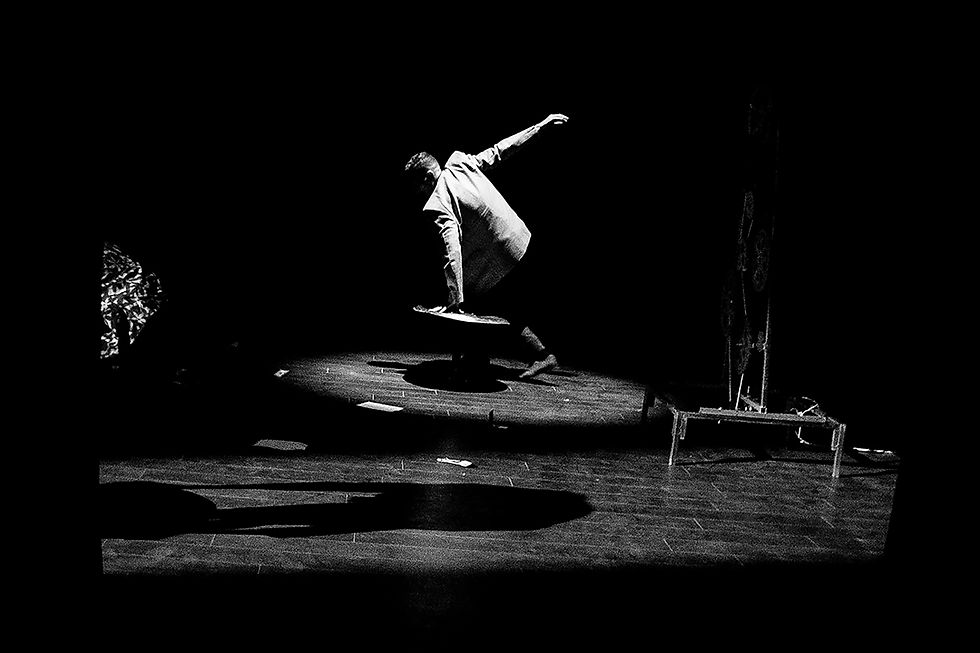
In the dim glow of a worn-out spotlight, four young Algerians from the western regions of the country take their places on a makeshift stage. Their play, titled Mékanizma, is not just a performance — it is a defiant act of love. A love for the theater, for storytelling, for art that persists in the face of invisibility.
Captured in stark black and white, this photo series follows a group of youth who have given everything for a dream most have long abandoned. They left behind their studies and job prospects to dedicate themselves fully to theater, not out of ambition for fame or financial gain, but for something deeper: a sense of purpose, belonging, and pride. Theater, for them, is not merely an art form — it is resistance. A way of being. A declaration of life amid the silence that often surrounds cultural initiatives in Algeria.
The project — Proscenium Ghosts — documents not only their performance but the unseen labor that precedes the applause. We see them rehearsing in cramped rooms, arguing over lines and lighting. We witness the physical strain of setting up the set with their own hands, hoisting steel beams and assembling wooden frames late into the night. There are moments of fatigue, laughter, and fleeting intimacy: a cigarette shared backstage, a quiet prayer whispered before the curtain rises, the tense joy of an audience finally reacting.
What makes this group remarkable is not just their commitment to the stage, but their fierce autonomy. In a country where institutional support for the arts is scarce and cultural policies remain stagnant, these young artists refuse to wait for permission. They craft their own path. They write, direct, build, and perform every aspect of their production. Mékanizma is theirs, in every sense.
The images also take us beyond the stage — into the vans that carry them from town to town, into the abandoned cultural centers where they rehearse without heating or air, into the streets where they engage passersby, painting murals and pasting up flyers in a desperate attempt to be seen. There is something deeply moving in their determination, in how they create something beautiful out of almost nothing.
Each frame in this series is a ghost story — one that speaks of presence despite erasure. These are the ghosts of a once-vibrant theatrical tradition in Algeria, now carried on the shoulders of the few who still believe. And yet, the ghost metaphor ends here. Because what we see is not death, but survival. Not silence, but a voice growing louder.
In the final image, the performers take their bow. Light floods the stage. The audience, modest but alive, rises in applause. Behind the actors, the shadows stretch long. But they do not fall back into them. They remain, defiantly visible.




Proscenium Ghosts speaks from Algeria, but the pressure it reveals is felt far beyond one country. Across the world, artists continue to build work inside unstable conditions, giving time, money, energy, and belief to practices that are too often praised before they are properly supported. Said Manseur’s photographs understand this contradiction. They do not turn struggle into romance. They show the cost of making art, and the dignity of those who continue regardless. In these young performers, we see a familiar truth: culture survives because artists keep carrying it, even when the structures around them arrive too late, or not at all.

The views, thoughts, and opinions expressed in the text belong solely to the author/s and are not necessarily shared by The Pictorial List.


