
REGINA: BOARDING SCHOOL LIFE AND DREAMS
A boarding school room becomes the frame for Cleopatra Joint’s portrait of ambition, instability, and a young woman’s search for freedom.
July 26, 2026
PICTORIAL STORY
PHOTOGRAPHY Cleopatra Joint
TEXT Melanie Meggs
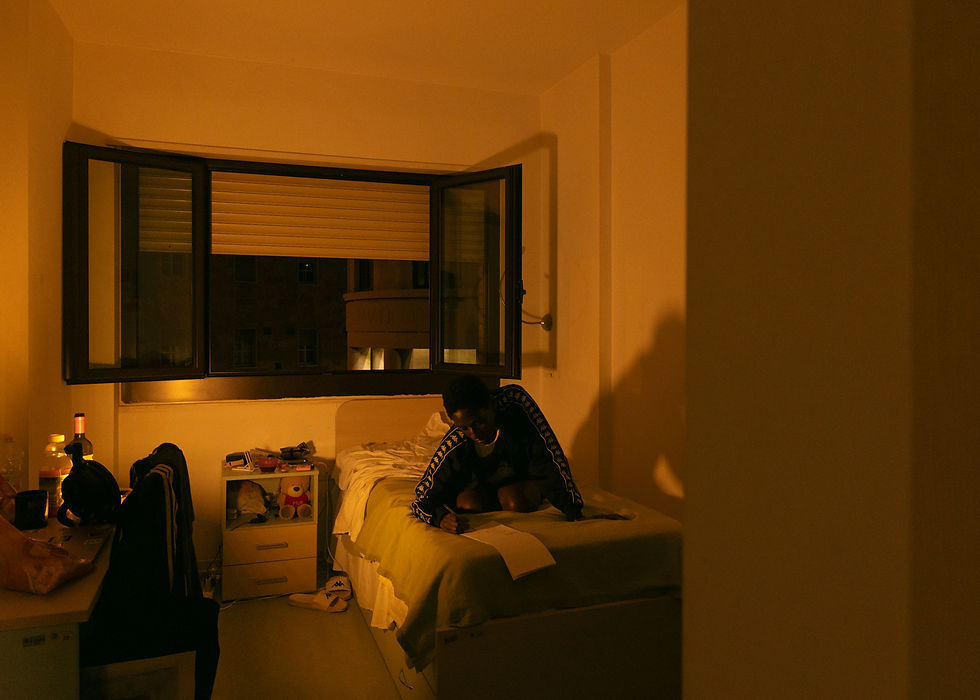
Visual artist Cleopatra Joint begins with the facts of a room: a bed, a desk, a wardrobe, a window, a few square metres. A temporary space in a boarding school in Bari becomes the setting for a young woman caught between study, modeling, love, uncertainty, and the wish to become someone closer to herself.
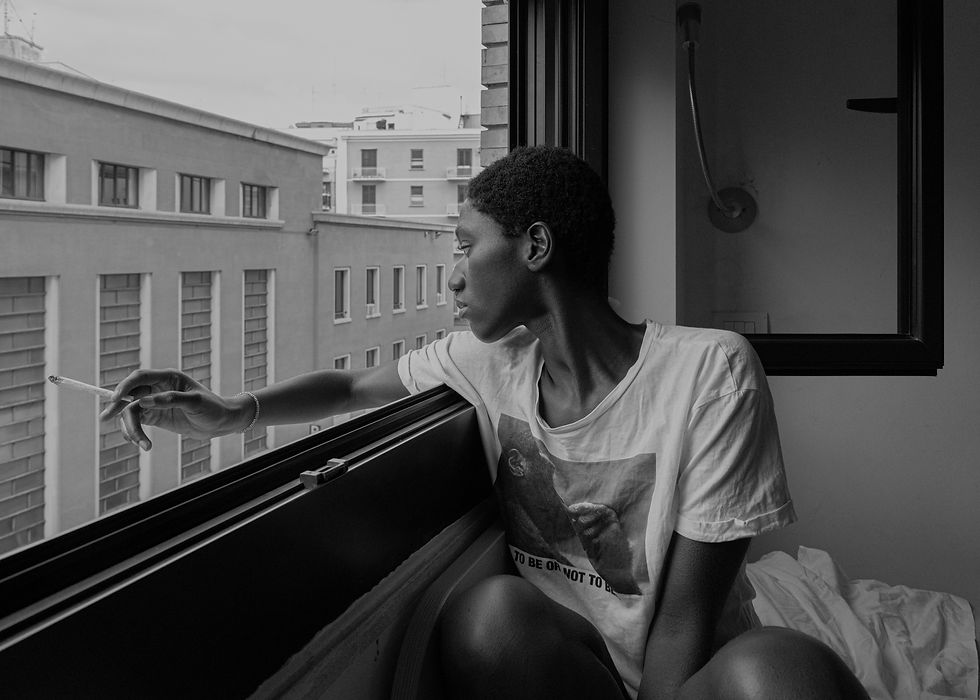
The young woman, Regina, left Rome years ago and now lives in Bari, dreaming of leaving university behind to make modeling her career. The room she inhabits is meant to function as home, though it remains provisional. It is too small, too temporary, too marked by transition. Cleopatra photographs this condition without overstating it. She stays with the ordinary facts of Regina’s afternoon and allows the emotional weight of the situation to surface slowly.
Born in Bari in 1996, where she continues to live and work, Cleopatra has developed a visual practice that moves between reality and a more dreamlike sensibility. Her work often turns toward emotional and relational dynamics, asking how people reveal themselves through rooms, gestures, silence, and the fragile structures of daily life. She is represented by YAH Factory gallery and has exhibited in Bari, Milan, and Paris, including Paris Photo OFF and One Shot in Milan. In 2025, she presented her first solo exhibition in Milan and was among the winners at the Bari Puglia International Film Festival. In 2026, she was selected by Comò to exhibit as part of Fotografia Europea at Atelier Due Gobbi.
-min.jpeg)
For Cleopatra, photography began with loss. As a child, she hated being photographed. She felt the camera as something invasive, especially at birthdays and gatherings where the image seemed to arrive from outside her own control. At eleven, something changed.
“It was an unconscious awareness that I needed to stop time in order to preserve something precious. At that age, I found my first close group of friends, and that was a great source of happiness for me. One summer afternoon, I felt an urge to capture an image of two of my friends playing on a merry-go-round. I took that photograph with my first mobile phone, and at the time, being so young, I had no understanding of digital storage or archiving. When that phone eventually stopped working, I lost a cherished memory in a very tangible way. Yet I still remember the photograph perfectly.”
That early loss continues to echo through Cleopatra’s practice. Photography became a way to hold what might vanish, but also a way to understand why certain moments remain so forcefully in the mind. Her images are not concerned with fixing life neatly. They work closer to the instability of memory, identity, and relation. The photograph becomes a place where something private can be brought into form without being entirely explained.
Her relationship with Bari is central to this way of seeing. Cleopatra describes the city through contradiction, saying she is not sure whether she loves it or hates it.
“What has certainly weighed on me is the sense of emptiness and boredom that often characterises life in Southern Italy: growing up in a working-class neighbourhood, having to scrape together money, pooling what little we had just to buy food, numbing ourselves so we wouldn’t have to think, those familiar experiences of many young people from provincial towns.”
She quotes the Italian rapper Marracash: “You steal our time, the only thing we have.” In Cleopatra’s work, this line does not sit as a cultural reference alone. It becomes a way to understand how time, in certain environments, can be both the only possession and the first thing taken. Bari is not simply the city where she works. It has shaped her sense of limitation, desire, and the emotional life of those trying to move beyond what was handed to them.
This understanding sits quietly inside this project. Regina’s dream is not treated as fantasy. It is shown as something that must exist alongside rent, study, uncertainty, and the practical demands of survival. Cleopatra sees her as courageous because she has accepted instability in order to pursue a life that feels more honest.
“Very few people are willing to accept an unstable or precarious life in pursuit of their dreams. Many of us become trapped by the logic of the capitalist system, and I don’t deny that, in the kind of society we live in, money is undeniably necessary. But life cannot be reduced to that alone.”
This sentence gives the project its tension. Regina is not simply waiting for life to begin. She is already inside the cost of wanting something different. Her dream of becoming a model is set against the reality of being at the beginning of that path, before recognition, before security, before certainty. Cleopatra does not make this conflict sentimental. She lets it remain unresolved.
They had met through Instagram, when Cleopatra was searching for new faces interested in sharing their stories.
“One afternoon, I simply asked if I could photograph her in her boarding school room — a tiny space that had somehow captivated me. She agreed, and the following day I documented her everyday life in what is supposed to be her home, but never quite feels like one, precisely because it is a boarding school room. I spent the day talking with her while taking photographs. We listened to music and shared a few joints. Nothing more. The work emerged naturally from that time together and, above all, from the trust she placed in me.”
That trust matters because the photographs are built through proximity rather than performance. Regina does not appear as a character created for the camera. She appears as someone allowing another person close enough to witness a private threshold. Cleopatra describes the entire project as “spontaneous observation,” guided by empathy and instinct. “Nothing was constructed,” she says.
Cleopatra was drawn to Regina’s sensitivity, her quietness, and the fact that she spoke very little about herself. This silence became part of the project’s structure. Where Cleopatra often describes her own inner world with precision, Regina seemed to carry hers in a different way.
“I often meet people who struggle to express who they are, and that fascinates me because I’m the opposite. I tend to describe my inner world with almost surgical precision. I believe that true isolation often lies in not allowing yourself the possibility of expressing yourself to others. Perhaps, in some way, what I’m trying to do through my work is to help bring that isolation to an end.”
The room reflects the condition of someone living between where she has come from and where she hopes to go. Its walls hold a private conflict: the desire for freedom pressed against the reality of a life still being assembled.
The project’s visual movement follows that conflict. Some images feel enclosed, drawing us into the weight of the room. Others suggest air, light, and the possibility of movement beyond it. Cleopatra’s use of black and white and colour is deliberate.
“I believe that black and white helps one enter a more introspective territory, but at a certain point I wanted there to be a sense of hope. Something that pushes us to keep fighting in such a complex world. For this reason, I introduced colour into the work. Initially, I used only the natural light coming from the window. Later, I added a LED light to create a more intimate and nocturnal atmosphere, because I associate warm light with our most private moments of solitude, especially at night.”
This movement between inwardness and hope is also tied to Cleopatra’s wider visual language. She began to recognise this language through lucid dreams, which she translated into photography while holding onto a neorealist approach. Italian cinema from the mid-twentieth century onward has shaped this sensibility. Her images are not an escape. They allow the inner life to sit beside the visible world. As Cleopatra says, “photographing is a way of processing my life. It is the only healthy method I know that truly allows me to understand myself and make sense of what happens to me.”
In Regina’s room, this language finds a precise subject. The boarding school space is factual, but it also holds the psychological pressure of transition. The photographs do not separate the visible from the internal. They allow one to press against the other. Regina’s body, the bed, the window, the evening light, and the limits of the room all become part of the same question: how does a person continue to dream while living inside conditions that make dreaming difficult?
This gives the project its broader social force, and is not only about a young woman in a room. It is about the pressure placed on young people to appear certain while living through instability. Cleopatra speaks directly about this pressure.
“We all pretend a little too much. We construct these online lives, carefully controlled, where we present ourselves as winners, but once we are behind the walls of our homes, we know the truth is different. We all have problems, but we are ashamed of them.”
For women, Cleopatra sees this struggle as even more obstructed. She speaks of a society shaped by sexism, where the path toward a career can become “a nightmare made of resistance.” Within this context, Regina’s dream of modelling carries complexity. To become visible is also to become vulnerable to judgement. Cleopatra’s photographs understand that tension. They do not confine Regina into beauty, ambition, or fragility. They hold these things together, because that is how they exist in life.
The title, Boarding School Life and Dreams, carries this double position. There is the daily fact of the room, and there is the dream pressing beyond it. Regina has joined a modelling agency in Puglia and is beginning to build that path. Cleopatra believes in her, but she also understands that belief alone does not remove fear. Dreams require foundations. They require time, discipline, money, and the ability to endure uncertainty without being destroyed by it.




In Regina: Boarding School Life and Dreams, Cleopatra Joint gives serious attention to a life in the middle of becoming. The project does not ask Regina to arrive at a conclusion. It stays with the moment before arrival, where desire is still forming and the future remains unresolved. Its strength lies in its refusal to overstate what it knows. The room is small, but Cleopatra allows it to hold the size of Regina’s uncertainty, and the full weight of her dream.
The views, thoughts, and opinions expressed in the text belong solely to the author/s and are not necessarily shared by The Pictorial List.


